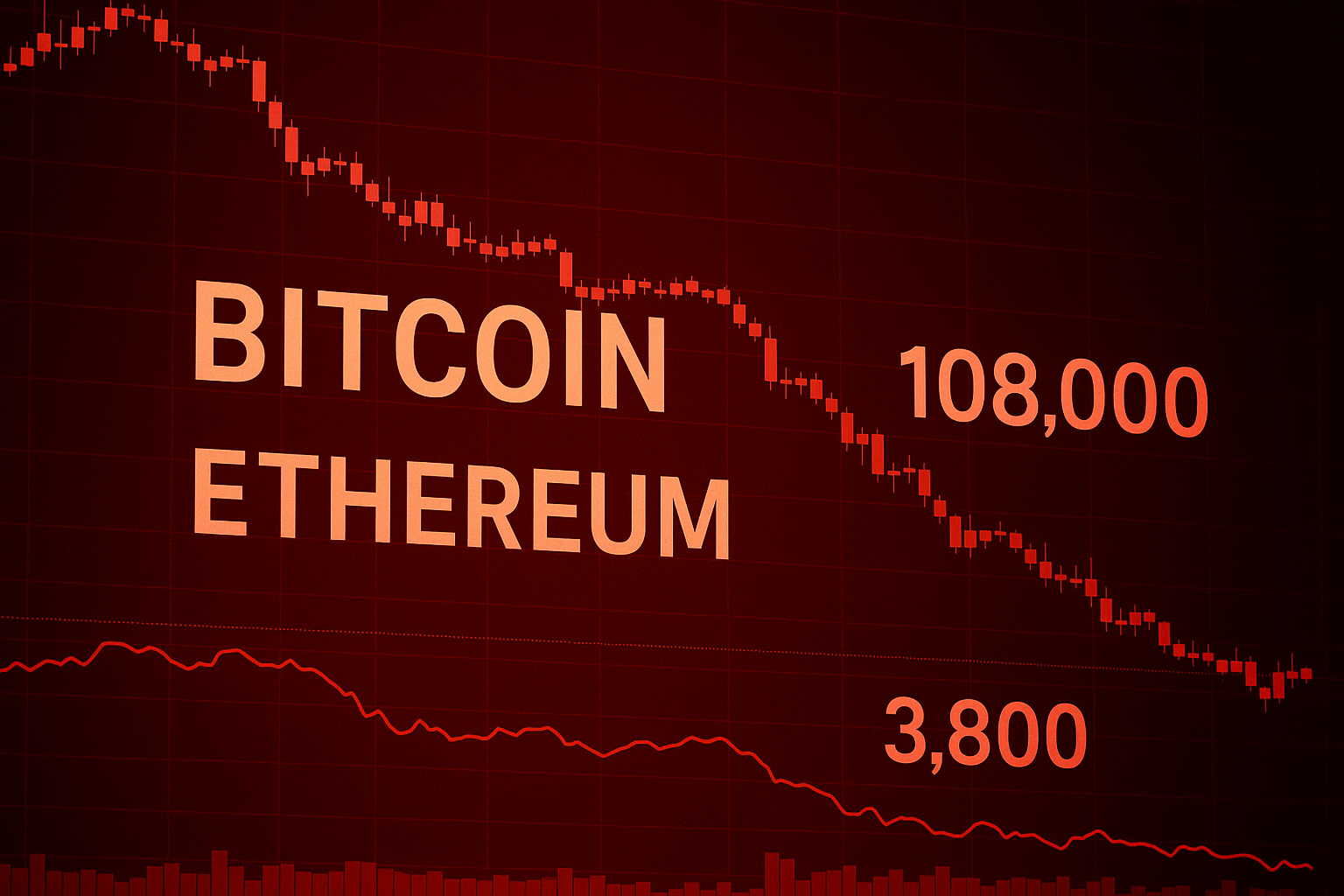
The cryptocurrency market faced renewed selling pressure on October 22, 2025, as Bitcoin fell below $110,000 for the first time this month and Ethereum slipped near $3,800, extending a weeklong downtrend that has shaken investor confidence. Despite continued optimism around institutional adoption and ETF expansion, traders remain cautious amid a broader risk-off sentiment across global markets.
Market Overview: Bitcoin and Ethereum Lead the Pullback
After starting the week near $112,500, Bitcoin (BTC) dropped to an intraday low of $108,000, marking a 3.2% daily decline. Ethereum (ETH) also slid by roughly 2.7%, trading around $3,780. Other major cryptocurrencies mirrored the dip, with Solana (SOL) and BNB both down more than 4%.
According to data from CoinMarketCap, the total global crypto market capitalization shrank by nearly 1%, settling around $3.74 trillion. While the scale of the correction remains moderate compared to past sell-offs, analysts warn that momentum indicators show weakening buyer confidence in the near term.
“The market is in consolidation mode,” said Clara Jennings, senior analyst at BlockData Research. “Investors are rotating from high-risk altcoins into more liquid assets like Bitcoin and stablecoins — a defensive move suggesting profit-taking rather than panic.”
Short-Term Weakness, Long-Term Strength
Despite the latest dip, several institutional traders view the correction as a healthy retracement within a long-term bullish cycle driven by ETF inflows and regulatory clarity. Since the approval of U.S. spot Bitcoin ETFs earlier this year, capital from pension funds and hedge funds has continued to enter the market — though at a slower pace during October.
Technical analysts note that Bitcoin’s 50-day moving average remains comfortably above $100,000, providing a strong support zone. “Unless BTC closes below $105K for multiple sessions, the broader trend remains bullish,” said Jennings.
Ethereum’s fundamentals also remain solid, buoyed by rising staking participation and Layer-2 scaling adoption. According to Glassnode, more than 31 million ETH is now locked in staking contracts — a sign that long-term holders are still accumulating.
Macro Factors Pressure Sentiment
The market downturn coincides with broader financial market volatility, triggered by renewed inflation fears and rising U.S. Treasury yields. Risk assets — including tech stocks and cryptocurrencies — are under pressure as investors anticipate a more cautious monetary stance from the Federal Reserve in its upcoming policy meeting.
In addition, lingering geopolitical uncertainty and slowing liquidity inflows in Asia have contributed to short-term volatility, particularly during overnight trading sessions in Hong Kong and Singapore.
“The crypto market continues to behave like a high-beta version of tech stocks,” explained Markus Reed, head of macro strategy at Alpha Edge Investments. “When Treasury yields rise and the dollar strengthens, digital assets tend to underperform — even when fundamentals are improving.”
Altcoins Underperform, Stablecoins Gain Market Share
While Bitcoin and Ethereum remain the dominant players, altcoins have suffered steeper losses. Avalanche (AVAX) and Cardano (ADA) both fell more than 6%, while meme-driven assets like Dogecoin and Shiba Inu slid nearly 8%.
Meanwhile, stablecoins such as USDT (Tether) and USDC (Circle) have seen inflows of over $1.2 billion in the past week, according to CryptoQuant. This movement suggests traders are hedging risk by moving into dollar-pegged assets while waiting for volatility to cool down.
What’s Next for the Market
Market watchers are closely monitoring Bitcoin’s next technical levels — with $108,000 as immediate support and $115,000 as short-term resistance. A decisive break below the $105K zone could trigger algorithmic selling, while a rebound above $112K may restore momentum for a year-end rally.
Despite the correction, fundamentals remain strong: institutional participation continues to expand, on-chain data shows accumulation among long-term holders, and ETF products are drawing steady inflows.
In summary:
The recent dip below $110,000 highlights the crypto market’s sensitivity to macroeconomic conditions, yet it does not signal a reversal of the broader bullish trend. For seasoned investors, these consolidations represent short-term turbulence within a long-term structural uptrend — a reminder that in crypto, volatility is not the enemy but the entry point for those with conviction.